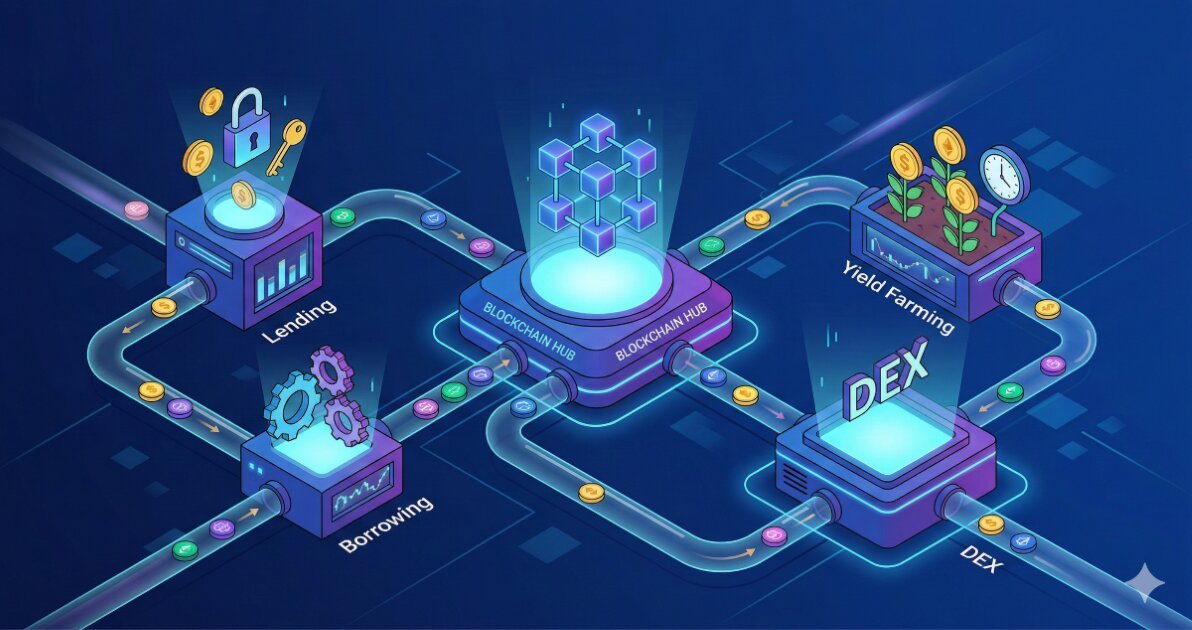
The crypto exchange market is fragmented across centralized venues, decentralized protocols, and hybrid aggregators, each with distinct settlement models, liquidity profiles, and execution mechanics. Understanding how orders route, fill, and settle across these venues matters for minimizing slippage, managing counterparty risk, and optimizing for speed or privacy. This article examines the technical architecture of exchange types, routing logic, and the decision points practitioners face when selecting execution paths.
Centralized Exchange Architecture
Centralized exchanges operate offchain order books with matching engines that typically process 100,000 to over 1,000,000 orders per second, depending on the platform. Orders rest in the book until matched by a taker or canceled. Settlement happens internally via database updates to user account balances. Blockchain transactions occur only during deposit and withdrawal.
The matching engine assigns priority by price, then time. Some venues also support conditional order types like stop-loss or iceberg orders that reveal only partial size. Collocation or API proximity to the matching engine reduces latency. Co-located bots often capture arbitrage opportunities within milliseconds.
Fee structures vary by maker/taker model, volume tier, and native token holdings. Taker fees typically range from 0.01% to 0.10%, maker fees from 0% to 0.05%. These fees change based on 30 day trailing volume and are subject to promotional adjustments.
Counterparty risk concentrates in the exchange’s custody system. If the exchange suffers a security breach, liquidity crisis, or regulatory freeze, user funds may become inaccessible regardless of blockchain state.
Decentralized Exchange Models
Decentralized exchanges execute onchain without an intermediary holding custody. Two dominant models exist: automated market makers (AMMs) and onchain order books.
AMMs use liquidity pools governed by constant product or similar formulas. A trade against a pool shifts the price along the bonding curve. Slippage increases nonlinearly with trade size relative to pool depth. Liquidity providers earn fees from each swap but face impermanent loss when the price ratio diverges from their deposit point.
Onchain order books replicate centralized exchange mechanics but record every order and fill as a blockchain transaction. This introduces latency (blocktime constrains throughput) and higher costs (gas per order). Most onchain order book DEXs migrate heavy computation to layer two networks or use off-chain order relay with onchain settlement to reduce costs.
Both models settle atomically in the same block as the trade. Users retain custody until the swap executes. No withdrawal queue exists because the user’s wallet address is the destination.
Routing Logic and Aggregation Layers
Aggregators query liquidity across multiple venues and route orders to minimize total cost, which includes price impact, fees, and gas. Routing algorithms split large orders across venues to reduce slippage in any single pool or book.
A routing engine calculates the expected output for each potential path. For a swap from asset A to asset B, the engine might evaluate direct pools (A/B), multihop routes (A/C/B), and centralized exchange APIs if the aggregator supports hybrid routing. The optimal path balances lower price impact against higher routing complexity and gas cost.
Some aggregators also offer intent based routing, where the user signs an intent to trade rather than a specific transaction. Solvers compete to fill the intent at the best price, often using private liquidity or just-in-time provisioning to improve execution.
Gas costs matter more for smaller trades. A route saving 0.5% on slippage but costing $20 more in gas fees is worse for a $500 trade than a simpler, higher slippage path.
Liquidity Fragmentation and Price Discovery
Price discovery happens differently across venue types. Centralized exchanges with high volume typically lead price discovery because their matching engines respond instantly to new information. DEXs follow with a lag determined by blocktime and arbitrage bot activity.
Arbitrage bots monitor price spreads across venues. When an exchange’s price deviates, bots buy on the cheaper venue and sell on the expensive one, narrowing the spread. The speed of this convergence depends on cross venue withdrawal times, gas fees, and bot competition.
Liquidity for the same pair can differ by an order of magnitude across venues. A pair with $10 million in liquidity on one DEX and $500,000 on another will exhibit vastly different slippage curves. Large traders often split orders temporally and spatially to avoid signaling intent.
Worked Example: Routing a $50,000 USDC to ETH Swap
A user wants to swap $50,000 USDC for ETH. The aggregator evaluates:
- Centralized exchange API: no gas cost, 0.05% taker fee, requires prior deposit and subsequent withdrawal (each costing $5 to $15 in network fees and 10 to 30 minutes).
- Uniswap V3 USDC/ETH 0.05% pool with $80 million liquidity: estimated 0.03% price impact, $8 gas fee.
- Curve USDC/ETH pool with $40 million liquidity: estimated 0.05% price impact, $9 gas fee.
- Split route (70% Uniswap, 30% Curve): estimated 0.025% combined price impact, $15 gas.
The aggregator selects the split route because the total cost (0.025% impact + $15 gas on a $50,000 trade = ~$27.50) beats the centralized exchange path ($25 taker fee + $10 deposit + $10 withdrawal = $45) and the single pool routes ($15 impact + $8 gas = $23 for Uniswap, but the split saves another $5).
If the user already holds funds on a centralized exchange, that path wins. If not, the onchain split is cheaper.
Common Mistakes and Misconfigurations
- Ignoring gas in routing cost calculations. Small trades often lose money to gas even when slippage looks favorable.
- Assuming API quoted prices equal execution prices. Centralized exchanges may show midpoint or best bid/ask, but taker orders walk the book if size exceeds top-of-book liquidity.
- Not accounting for withdrawal wait times. A better centralized exchange price is irrelevant if you need the asset onchain in the next block.
- Using stale liquidity data for routing. Pool reserves change every block. Routing decisions based on data more than a few blocks old may execute at worse prices.
- Omitting slippage tolerance checks. Transactions revert if actual slippage exceeds the tolerance parameter, wasting gas. Setting tolerance too high invites MEV extraction.
- Depositing to a centralized exchange without confirming withdrawal functionality. Some exchanges pause withdrawals for specific assets during network upgrades or liquidity crunches.
What to Verify Before You Rely on This
- Current fee schedules for your volume tier on each venue you use. Exchanges adjust fees quarterly or during promotions.
- Liquidity depth for your trading pair at your intended trade size. Use recent onchain data or exchange API depth snapshots.
- Withdrawal processing times and any minimum holding periods on centralized exchanges.
- Gas price at intended execution time. Network congestion can multiply routing costs.
- Smart contract audit status and age for any DEX or aggregator. Newly deployed or unaudited contracts carry additional risk.
- Regulatory restrictions affecting your jurisdiction. Some centralized exchanges restrict access or freeze accounts based on location.
- Oracle price sources if using limit orders on DEXs. Misconfigured oracles can trigger fills at unfavorable prices.
- Aggregator solver reputation and execution history if using intent based routing. Solver selection affects fill quality.
- Current blockchain congestion and mempool state. High pending transaction counts delay settlement and increase frontrunning risk.
Next Steps
- Benchmark execution quality across your most used venues by logging actual fill prices, fees, and gas costs for a sample of recent trades.
- Set up monitoring for liquidity changes in your primary trading pairs, either via subgraph queries for onchain pools or API polling for centralized venues.
- Test routing behavior for edge cases like low liquidity pairs, high volatility periods, or network congestion to understand when your preferred path degrades.
Category: Crypto Exchanges