Native markets refer to trading venues and liquidity infrastructure built directly on blockchain settlement layers, where order matching, execution, and settlement occur within the same trust boundary as the underlying assets. Unlike venues that bridge to offchain matching engines or custodial exchanges, native markets use onchain programs (smart contracts, runtime modules, or appchain logic) to enforce trade validity, manage collateral, and finalize transactions. The architectural choice carries specific consequences for latency, composability, MEV exposure, and regulatory classification. This article examines the mechanics that differentiate native markets, the trade-offs operators and integrators face, and the verification steps required before routing order flow.
Execution and Settlement in a Single Trust Domain
Native markets eliminate the custodial handoff between trade execution and settlement. On Ethereum, this typically means a smart contract that holds an order book or AMM reserves and settles trades atomically within the same transaction that matches them. On Solana, the Serum (now OpenBook) model uses a central limit order book program that processes taker orders against resting maker orders in a single slot. Appchains like dYdX v4 embed the matching engine in the consensus layer itself, so validators both sequence and settle trades.
The shared characteristic is that the same validator set or execution environment that finalizes state transitions also enforces trade rules. There is no intermediary custodian holding user funds between order submission and settlement. Collateral remains in user controlled accounts or program derived addresses (PDAs) governed by protocol rules, not operator discretion.
Composability and Atomic Execution Paths
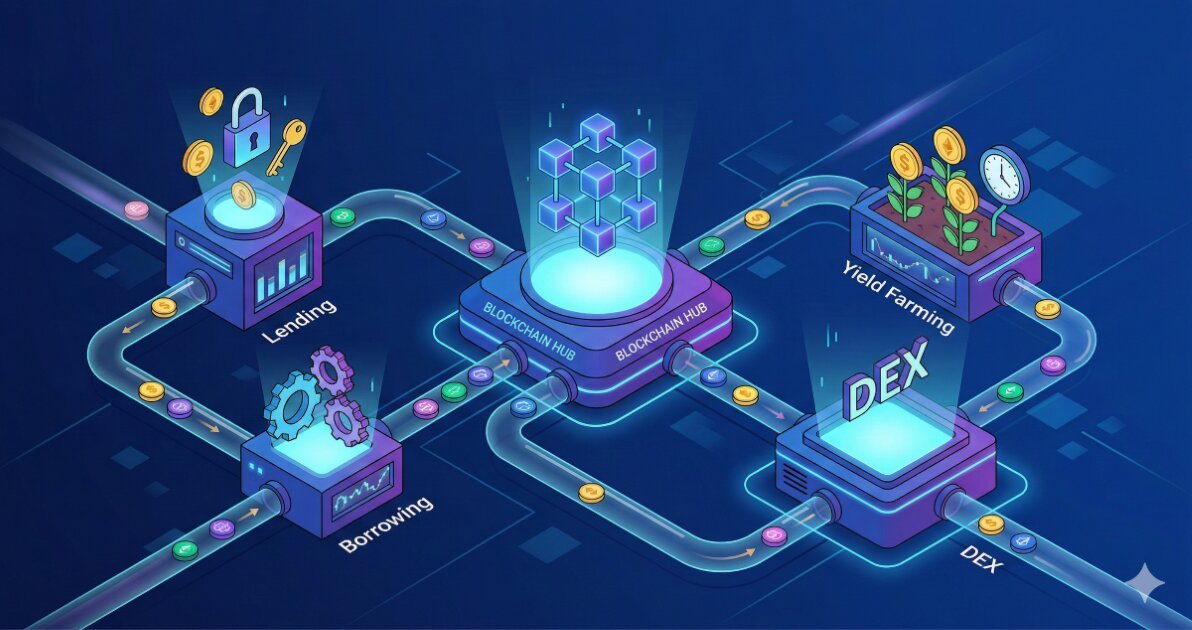
Because native markets settle onchain, they can participate in atomic multi-step transactions. A user can flash loan assets, execute a swap on a native DEX, deposit the proceeds into a lending protocol, and repay the loan in a single transaction. If any step fails, the entire sequence reverts. This property enables arbitrage strategies, liquidation bots, and collateral rebalancing that depend on guaranteed atomicity.
For example, a liquidator on a lending protocol can borrow collateral, sell it on a native AMM, repay the debt, and pocket the difference in one transaction. The AMM does not need to trust the liquidator’s solvency. The transaction either completes in full or leaves no state change. This composability is why native markets became infrastructure primitives for DeFi protocols during the 2020 to 2022 period, though integrators should verify current contract upgrade paths and oracle dependencies before assuming atomicity guarantees hold under all conditions.
Latency, Throughput, and MEV Surface
Native markets inherit the performance ceiling of their host chain. On Ethereum mainnet, block times of approximately 12 seconds and gas auctions create opportunities for frontrunning and sandwich attacks. Searchers monitor the mempool, detect profitable trades, and insert transactions immediately before and after a target swap to extract value. This MEV exposure is intrinsic to transparent mempools and atomic settlement. Users can mitigate it via private transaction pools (Flashbots Protect, MEV Blocker), slippage limits, or limit orders, but the attack surface persists as long as transaction ordering is auctioned.
High throughput chains like Solana reduce per-slot latency but introduce different trade-offs. Validator hardware requirements rise, and network congestion during volatility spikes has historically caused transaction drops and partial fill uncertainty. Native markets on these chains benefit from sub-second confirmation but require integrators to handle retry logic and partial execution states.
Appchains that embed matching engines in consensus can batch trades before broadcasting, reducing MEV leakage. dYdX v4, for instance, processes orders in a private mempool and only publishes final state updates. This design narrows the MEV surface but centralizes sequencing trust in the validator set, a trade-off that shifts risk from transaction ordering attacks to validator collusion or censorship.
Collateral Management and Margin Mechanics
Native markets using perpetual futures or margin trading must manage collateral and liquidations onchain. Protocols typically monitor account health via price oracles (Chainlink, Pyth, or internal TWAP feeds) and allow keepers to liquidate undercollateralized positions. The liquidation threshold, insurance fund mechanics, and keeper incentive structure are encoded in the protocol contract or runtime module.
For instance, a native perps market might check collateral every block. If an account’s margin ratio drops below the maintenance threshold (say, 3% of notional position size), the contract allows any caller to liquidate a portion of the position in exchange for a liquidation fee (often 1% to 2% of the liquidated value). The insurance fund absorbs losses if liquidations do not cover the shortfall. These parameters are protocol specific and change through governance votes or admin multisig actions. Integrators should query current thresholds directly from the contract rather than relying on outdated documentation.
Regulatory and Counterparty Considerations
Native markets occupy ambiguous regulatory territory. Because they operate via immutable or governance controlled smart contracts, no single entity may fit traditional definitions of an exchange operator or custodian. However, teams that deploy and upgrade these contracts, control admin keys, or run frontend interfaces may face enforcement actions depending on jurisdiction.
The CFTC has asserted jurisdiction over certain DeFi protocols offering derivatives, and the SEC has argued that some tokens traded on native markets qualify as unregistered securities. The regulatory posture shifts over time and across regions. Integrators should consult current enforcement actions and legal opinions rather than assume decentralized architecture exempts a protocol from compliance requirements.
Worked Example: Liquidation Flow on a Native Perps DEX
Alice holds a 10 ETH long perpetual position with 0.5 ETH collateral (20x leverage) on a native perps protocol. The protocol checks her margin ratio every block using a Chainlink oracle. The maintenance margin is 3%, so her position remains safe as long as collateral value exceeds 3% of notional exposure (0.3 ETH at current price).
ETH price drops 8% in five minutes. Alice’s collateral is now worth 0.46 ETH in USD terms, while her position requires 0.276 ETH minimum (3% of the new notional). She remains above water, but another 5% drop would trigger liquidation.
A keeper bot monitors the protocol state. When ETH falls another 6%, Alice’s margin ratio hits 2.8%. The contract allows the keeper to call liquidate(Alice, partialSize). The keeper closes 50% of Alice’s position, collects a 1.5% liquidation fee (0.0207 ETH), and the protocol deducts the remaining loss from Alice’s collateral. The insurance fund is not tapped because the liquidation was timely. Alice retains half her position and reduced collateral.
The entire sequence occurs in one block. The keeper’s transaction either succeeds atomically or reverts if another keeper front runs it. No offchain coordination or settlement delay exists.
Common Mistakes and Misconfigurations
- Assuming slippage protection applies across all native market types. AMMs enforce slippage limits via minimum output parameters, but order book markets may fill limit orders at worse prices if liquidity shifts between submission and execution. Always specify limit prices on taker orders.
- Ignoring oracle lag during volatile periods. Native markets relying on external price feeds can liquidate positions based on stale data if oracle update frequency does not match market conditions. Confirm oracle heartbeat and deviation thresholds before using high leverage.
- Treating governance multisig as equivalent to immutability. Many native markets retain admin keys for emergency pauses or parameter updates. A compromised multisig can drain funds or alter trading rules. Check current admin permissions and timelock delays.
- Not accounting for gas cost in arbitrage or liquidation strategies. Onchain execution means gas fees eat into profit margins. Strategies profitable at 20 gwei may fail at 100 gwei. Model gas spikes before deploying keeper bots.
- Assuming atomic composability across all chains. Some chains do not support synchronous cross contract calls or revert all state changes on failure. Verify atomicity guarantees for the specific runtime before building multi-step flows.
- Overlooking frontend interface risk. Even if the protocol is noncustodial, a malicious or compromised frontend can redirect trades, substitute addresses, or inject phishing prompts. Verify contract addresses and transaction details in a block explorer before signing.
What to Verify Before Relying on Native Markets
- Current admin key holders and timelock durations for protocol upgrades.
- Oracle provider, update frequency, and fallback logic during feed outages.
- Insurance fund balance and capitalization relative to open interest.
- Liquidation threshold, penalty fees, and keeper incentive parameters.
- Gas cost estimates for typical trade sizes under current network congestion.
- Contract audit reports and known issues or exploit history.
- Governance proposal queue for pending parameter changes.
- Mempool privacy options or MEV mitigation tools available on the host chain.
- Legal opinions or regulatory actions targeting the protocol or its operators.
- Withdrawal or settlement delays for cross layer or bridged liquidity.
Next Steps
- Query protocol contracts directly (via Etherscan, Solscan, or a node RPC) to confirm margin requirements, fee structures, and admin permissions rather than trusting documentation.
- Test small trades or liquidations on testnets or with minimal capital to observe actual execution behavior, gas consumption, and failure modes.
- Monitor protocol governance channels and audit reports for upcoming changes to risk parameters, oracle dependencies, or contract logic that could affect existing integrations.
Category: Crypto Exchanges